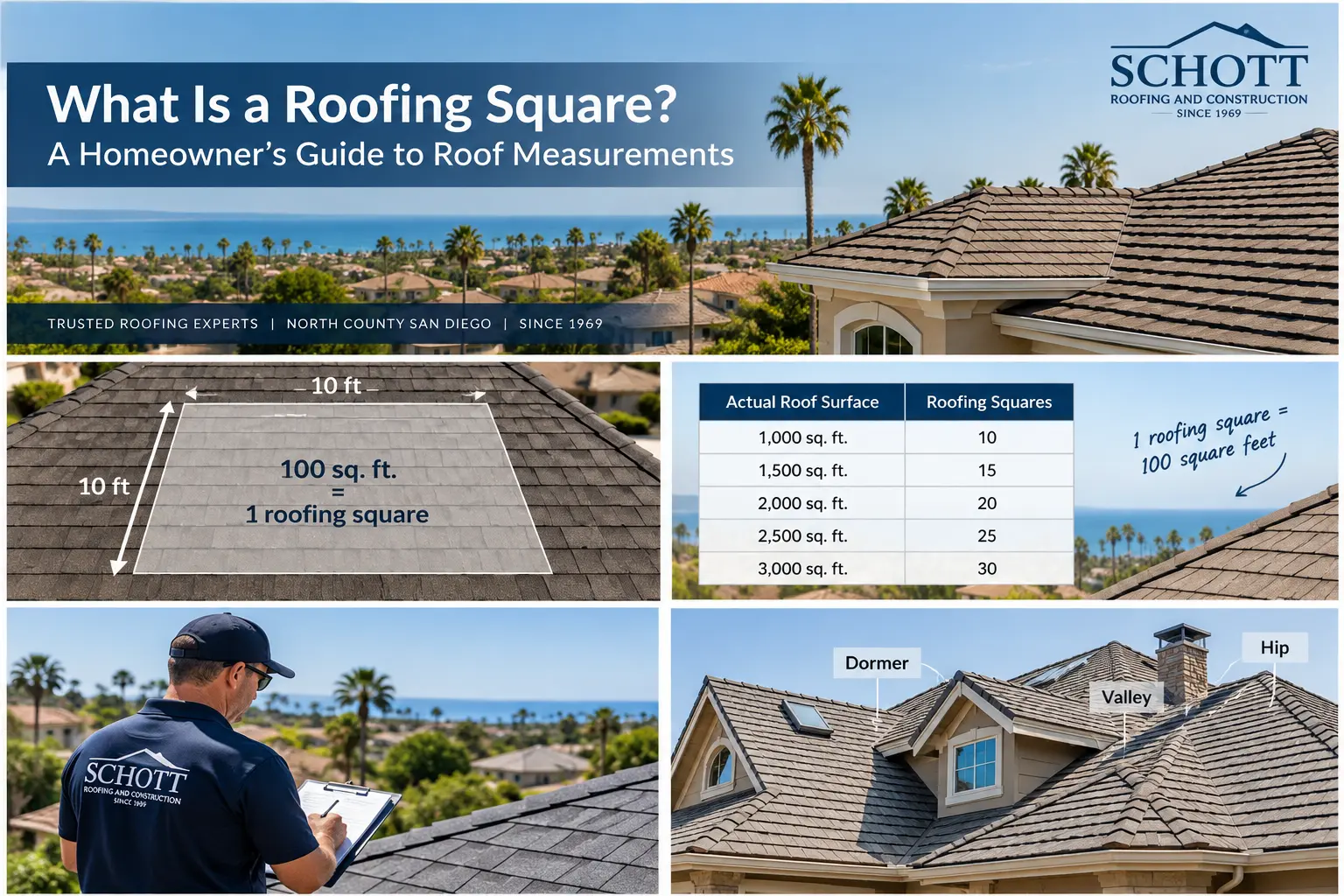
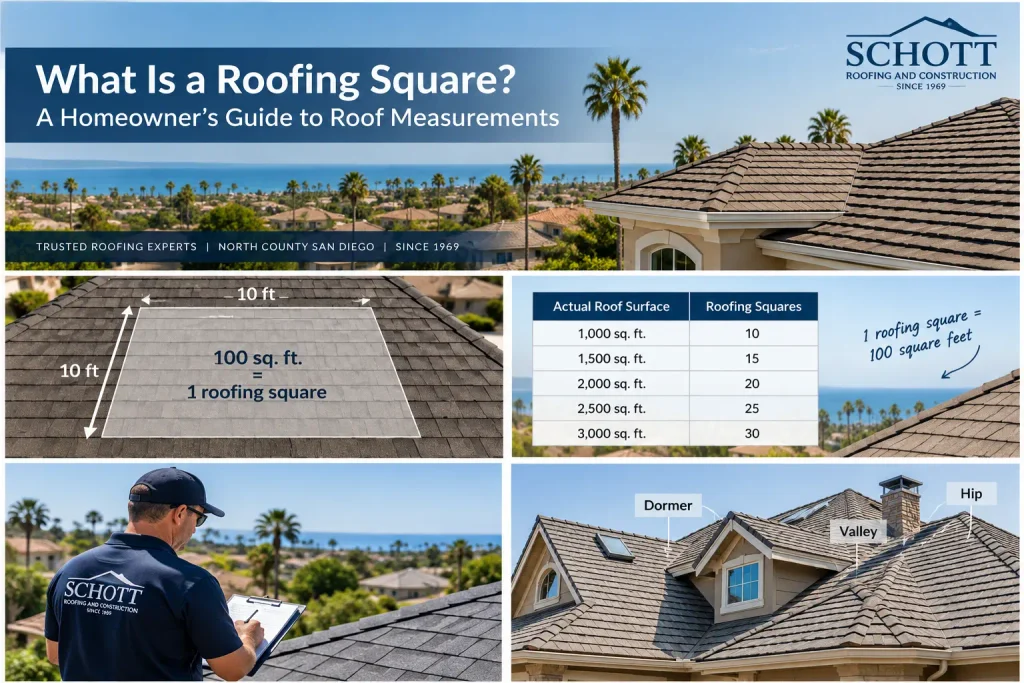
Not sure how roofers measure a roof? This visual explains roofing squares, roof surface area, and the measurements that help determine the scope of a roofing project.
When you receive a roofing estimate, you may come across a term that isn’t used in everyday conversation: roofing square.
A roofing square is a standard unit of measurement equal to 100 square feet of actual roof surface. Roofing professionals use squares to estimate the size of a roof, calculate material requirements, and help determine labor and project costs.
The important part is that a roofing square measures the roof itself, not simply the square footage of your home.
Once you understand how roofing squares work, it becomes much easier to read a roofing estimate and understand what your contractor is actually measuring.
What Is a Roofing Square?
One roofing square equals 100 square feet of roof surface.
A simple way to visualize it is a 10-foot-by-10-foot area:
10 ft × 10 ft = 100 sq. ft. = 1 roofing square
The term “square” refers to the amount of area, not the shape of the roof. A roof can have multiple slopes, valleys, hips, dormers, and other features and still be measured in roofing squares.
For example, a roof with 2,400 square feet of actual surface area would contain:
2,400 ÷ 100 = 24 roofing squares
This gives you the basic measured roof area before considering additional material requirements.
How Many Square Feet Are in a Roofing Square?
There are 100 square feet in one roofing square.
The basic conversion is:
Roofing squares = Roof surface area ÷ 100
| Actual Roof Surface | Roofing Squares |
| 1,000 sq. ft. | 10 |
| 1,500 sq. ft. | 15 |
| 2,000 sq. ft. | 20 |
| 2,500 sq. ft. | 25 |
| 3,000 sq. ft. | 30 |
These numbers work when you’re starting with the actual roof surface area.
Why Do Roofers Use Squares?
Roofing squares give contractors a standardized way to describe the size of a roofing project.
Instead of repeatedly working with large square-foot measurements, a roofer can say, “This roof is approximately 25 squares.”
That measurement can then be used as part of the process for estimating:
- Roofing materials
- Labor
- Roof removal
- Underlayment
- Installation
- Material delivery
- Other project requirements
However, the number of roofing squares doesn’t determine the final project price by itself.
Two roofs with the same square count can have different costs because of differences in roofing materials, roof design, accessibility, existing damage, labor, and the scope of work.
Is a Roofing Square the Same as a Square Foot?
No.
A square foot is one unit of area.
A roofing square is 100 square feet of actual roof surface.
So:
1 roofing square = 100 square feet
For example:
2,500 square feet ÷ 100 = 25 roofing squares
The distinction becomes particularly important when you’re comparing your home’s advertised square footage with the size listed on a roofing estimate.
Does a Roofing Square Measure the Roof or the House?
A roofing square measures the actual surface of the roof, not the home’s interior floor area.
This means a 2,000-square-foot home does not necessarily have a 2,000-square-foot roof.
A roof is often sloped, and its surface can be larger than the horizontal footprint of the building. Overhangs, multiple roof sections, dormers, valleys, hips, garages, porches, and other architectural features can also affect the final measurement.
For this reason, a contractor needs to evaluate the roof itself when determining its square count.
The home’s square footage is a starting point—not a substitute for an actual roof measurement.
How Is a Roof Measured in Roofing Squares?
The basic process is to determine the total surface area of the roof and then convert that measurement into roofing squares.
Measure the Roof Sections
A simple roof may have only a few large planes, while a more complex roof can contain several individual sections.
Each relevant section needs to be accounted for when determining the total roof surface.
Account for Roof Pitch
Roof pitch describes how steep a roof is.
Because a sloped roof has more surface area than its horizontal footprint, pitch affects the amount of roofing material required.
This is one reason you can’t reliably calculate roofing squares simply by looking at the home’s floor area.
Calculate the Total Roof Surface
Once the individual sections and their dimensions are accounted for, they can be combined to determine the total roof surface area.
For example, suppose the measured roof surface is 2,600 square feet.
Convert the Surface Area Into Squares
Divide the roof surface area by 100:
2,600 ÷ 100 = 26 roofing squares
The roof therefore measures approximately 26 squares before additional material allowances.
Why Does Roof Pitch Affect Roofing Squares?
Roof pitch matters because roofing materials cover the sloping surface, not the horizontal footprint of the house.
Imagine two homes with identical footprints. One has a lower-slope roof, while the other has a steeper roof.
The steeper roof generally has more actual surface area.
That’s why this assumption isn’t reliable:
“My home is 2,000 square feet, so my roof must be 20 squares.”
The actual roof size depends on the roof’s dimensions, pitch, design, and other features.
How Does Roof Design Affect Roof Measurements?
Roof geometry can make one roof considerably different from another, even when the homes have similar floor areas.
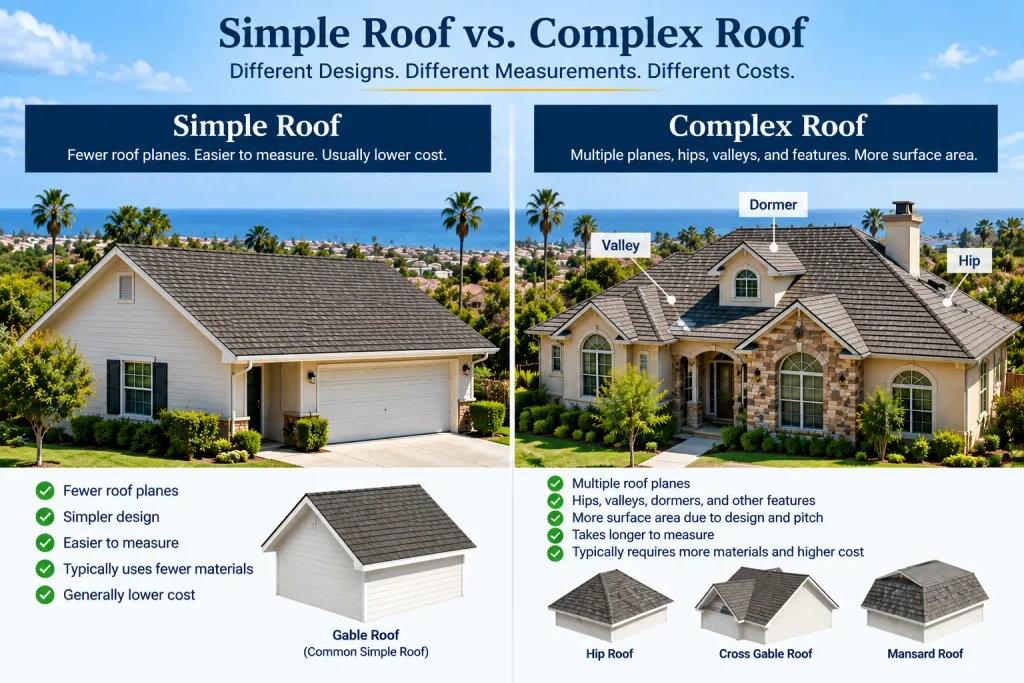
A simple gable roof may have two large roof planes.
A more complex roof might include:
- Multiple hips
- Valleys
- Dormers
- Different roof slopes
- Extensions
- Several roof sections
- Roof penetrations
These features can affect the total roof surface and the amount of material needed to complete the installation.
Simple Roof vs. Complex Roof
Consider two hypothetical homes.
Home A has a simple gable roof with two large planes.
Home B has multiple roof sections, valleys, dormers, and different slopes.
Even if the homes have similar floor areas, their roofing measurements and material requirements can be different.
A complex roof also requires more detailed measurements and more cutting around transitions and other features.
How Many Shingles Are in a Roofing Square?
This is a common question, but there isn’t one universal answer for every roofing product.
You may hear that a certain number of asphalt shingle bundles covers one roofing square. While many common products are packaged around standard coverage amounts, coverage varies by manufacturer and product.
It can depend on:
- Shingle design
- Manufacturer specifications
- Bundle coverage
- Installation method
- Roof design
That’s why material quantities should be based on the specific product’s stated coverage rather than assuming every shingle uses exactly the same amount.
A roofing square tells you how much roof area needs to be covered. It doesn’t automatically tell you how many bundles, tiles, panels, or other individual pieces will be needed.
Do Roofing Squares Include Waste?
The measured roof area and the amount of material purchased aren’t necessarily identical.
Roofing materials often need to be cut and fitted around areas such as:
- Valleys
- Hips
- Ridges
- Rakes
- Dormers
- Roof penetrations
- Edges
- Other complex features
A simple roof may require less additional material than a roof with numerous intersections and detailed sections.
The appropriate material allowance depends on the roofing product, roof design, installation requirements, and project conditions.
So if a contractor measures your roof at 25 squares, that doesn’t necessarily mean exactly 25 squares of packaged material will be ordered.
What Does “Price Per Square” Mean in Roofing?
When a contractor refers to a price per square, they’re using the roofing square as a unit for describing part of the project’s cost.
For example, using a hypothetical rate of $500 per square:
20 squares × $500 = $10,000
That is only a mathematical example, not a typical roofing price.
Actual roofing costs depend on factors such as:
- Roofing material
- Roof pitch
- Roof design
- Existing roof condition
- Labor
- Accessibility
- Removal and disposal
- Repairs
- Project scope
For that reason, homeowners should compare the complete scope of work, rather than comparing a price-per-square figure alone.
How Do Roofing Squares Affect a Roofing Estimate?
The square count is one part of a roofing estimate.
A complete proposal may also include:
- Existing roof removal
- Disposal
- New roofing materials
- Underlayment
- Flashing
- Drip edge
- Ridge components
- Ventilation
- Decking repairs
- Labor
- Cleanup
This explains why two roofs with the same number of squares can have very different project costs.
A 25-square roof with a simple design and minimal repairs may have a very different scope from a 25-square roof with multiple valleys, difficult access, damaged decking, and additional work.
The square count tells you about roof area; it doesn’t describe the entire project.
What Should Homeowners Look for on a Roofing Estimate?
If you’re reviewing a roofing estimate, ask questions about the numbers rather than focusing only on the final price.
How Many Roofing Squares Does My Roof Have?
This tells you the measured size of the roofing surface.
How Was the Roof Measured?
Ask whether the measurement accounts for roof pitch, individual roof sections, and other important features.
What Roofing Material Is Included?
Different roofing products have different coverage and installation requirements.
Is Additional Material Included?
Ask how the contractor has accounted for cuts, roof complexity, and other material requirements.
Are Repairs Included?
If the existing roof has damaged decking, flashing, or other components, ask whether those repairs are included in the proposal.
What Does the Price Per Square Include?
Make sure you understand whether the quoted amount includes materials, labor, removal, disposal, repairs, and other project-specific work.
A detailed estimate makes it much easier to understand what you’re actually paying for.
Common Mistakes Homeowners Make When Estimating Roof Size
Assuming House Square Footage Equals Roof Size
The home’s floor area doesn’t automatically equal the actual roof surface.
Ignoring Roof Pitch
The slope of the roof affects the amount of surface that needs to be covered.
Assuming Every Roof Has the Same Material Requirements
Roofing materials differ in coverage and installation requirements.
Treating the Square Count as the Final Price
The number of squares describes the roof area, not the entire project scope.
Measuring the Roof Without Considering Safety
Climbing onto a roof simply to take measurements can create unnecessary fall risks. Professional measurement is a safer option when an accurate measurement is needed.
Can You Calculate Roofing Squares Yourself?
You can make a basic estimate using measurements, architectural plans, satellite measurements, or other available information.
However, an accurate roofing measurement may need to account for:
- Roof pitch
- Individual roof planes
- Overhangs
- Valleys
- Hips
- Dormers
- Roof penetrations
- Roof geometry
- Material requirements
For anything beyond a rough estimate, professional measurement can provide a more reliable basis for a roofing project.
Not sure how many roofing squares your North San Diego County home has? A professional roof evaluation can account for the roof’s design, pitch, and condition instead of relying only on the home’s square footage.
When Should You Have Your Roof Professionally Measured?
A professional measurement can be useful when you’re:
- Planning a roof replacement
- Comparing multiple roofing estimates
- Unsure about your roof’s size
- Trying to understand a contractor’s square count
- Dealing with a complicated roof design
- Evaluating an older roof
- Planning a new roofing project
A professional can evaluate the roof’s dimensions, pitch, materials, design, and existing condition when determining the appropriate scope of work.
Roofing Squares and North San Diego County Homes
Homes throughout North San Diego County have a wide variety of roof designs and materials.
Schott Roofing & Construction serves homeowners in communities including Vista, Oceanside, Carlsbad, Encinitas, San Marcos, Escondido, Fallbrook, and surrounding areas.
Depending on the property, a homeowner may have an asphalt shingle roof, tile roof, metal roof, wood roofing, or another roofing system.
Because roof designs vary, the actual roof surface needs to be considered when preparing a roofing estimate.
Understanding roofing squares can make it easier to follow the numbers on an estimate and ask useful questions about the work being proposed.
If you’re planning a roofing project and want to understand your roof’s size and condition, consider having your roof professionally evaluated before making a decision.
Frequently Asked Questions About Roofing Squares
A roofing square is a standard roofing measurement equal to 100 square feet of actual roof surface.
There are 100 square feet in one roofing square.
Determine the actual roof surface area and divide it by 100.
For example:
2,500 square feet ÷ 100 = 25 roofing squares.
You cannot determine the exact number from the home’s floor area alone. Roof pitch, design, overhangs, and other features affect the actual roof surface.
Yes. A sloped roof generally has more actual surface area than its horizontal footprint, so pitch needs to be considered when measuring the roof.
No. A roofing square measures area. The number of bundles required depends on the specific roofing product and its manufacturer-rated coverage.
The measured square count represents the roof area. Additional material may be needed for cuts, roof complexity, installation requirements, and other project conditions.
You can make a basic estimate, but an accurate measurement may require accounting for pitch, multiple roof planes, overhangs, valleys, hips, dormers, and other details. You should not climb onto a roof simply to obtain a measurement.
Roofing squares provide a standardized way to describe roof surface area and help contractors discuss material quantities, labor, and project scope.
The square count describes roof area, not the complete scope of work. Roofing material, roof design, accessibility, existing damage, labor, removal, repairs, and other project requirements can all affect the final cost.
Final Thoughts
A roofing square equals 100 square feet of actual roof surface, but understanding that definition is only the beginning.
Your home’s floor area isn’t necessarily the same as its roof area. Roof pitch, design, overhangs, valleys, hips, dormers, and other features can change the amount of surface that needs to be covered.
The square count is also only one part of a roofing estimate. Materials, labor, roof condition, accessibility, removal, repairs, and project scope all matter when determining the work involved.
If you’re reviewing a roofing estimate, ask how the roof was measured, how many squares were calculated, what materials and services are included, and whether additional work may be required.
For homeowners in North San Diego County, a professional roof evaluation can help you understand your roof’s actual size, condition, and the work that may be needed.